
D.5 APPEARANCE OF THE BLACK CRUST
One of the main products from the interaction between today’s atmosphere and the building materials (interaction between mortar and sulphur dioxide –SO2–) is gypsum (CaSO4·2H2O). Gypsum is formed by the oxidation/hydration of sulphur dioxide –SO2– when it reacts with rainwater, which forms sulphuric acid that then reacts with thecalcium carbonate –CaCO3– in the mortar. This reaction leads to the formation of the so-called black crusts, which are made up mainly of gypsum and calcium carbonate, and to a lesser extent of particles of carbon and heavy metals from the airborne deposit.
The black crusts found at the Punta Begoña Galleries contain deposits of sodium chloride (common salt) and metals manganese (Mn), iron (Fe), lead (Pb), titanium (Ti) and chrome (Cr) trapped in the material. The sodium chloride has come from sea spray, as its main component, and the metals are deposits of particulate material from car exhaust fumes and industry.
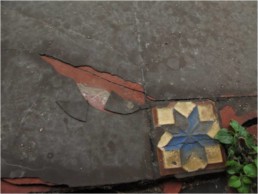
Black crust found on the floor in the north-west gallery, 2017. Source: Project for showcasing the Punta Begoña Galleries