
C.10 SAND AND LIME
Human beings have used mortar in construction since time immemorial. It can be made from a range of aggregates and binders such as lime, earth, gypsum and cement.
In constructing the Punta Begoña Galleries several mortars with different compositions and aggregates were used for different purposes.
The tiles, the ornamental stone slabs in the main hall, the sandstone blocks in the base wall, the bricks and the balustrade are all set into render-type mortar.
Several layers of smoother, decorative plaster mortar can clearly be seen at the tops of the walls in all the galleries and on the ceilings. In the main hall the murals are painted directly onto the plaster, while in the corridors of the galleries a wide range of ornamental features such as cloverleaf designs and geometrical symbols are also picked out in plasterwork. The pillars, the exterior columns and the reinforced concrete angle pieces on the façade are also clad in several layers of mortar.
One of the main components of mortar is sand. In the construction of these galleries considerable use was made of beach sand: indeed, fragments of seashells are clearly visible in it.
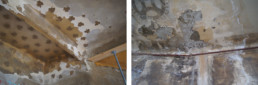
Left: cloverleaf decorative motifs in plasterwork on the ceiling of the north-west gallery. Left: geometrical decorative motifs in plasterwork on the ceiling and wall of the south-west gallery. 2017 Source: Project for showcasing the Punta Begoña Galleries
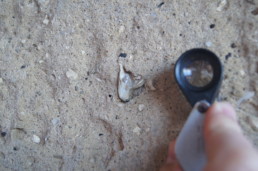
Photo showing mortar containing oyster-shell in the south-west gallery, 2017. Source: Project for showcasing the Punta Begoña Galleries
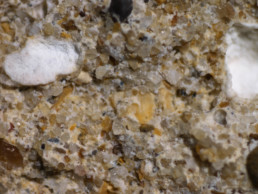
Magnified image of the render-type mortar used in the south-west gallery, 2017. Source: Project for showcasing the Punta Begoña Galleries