
D.14 RUSTING ON THE REINFORCED CONCRETE
Reinforced concrete is stable and resistant thanks to its alkaline protection: the alkaline environment provided by the compounds forming when the concrete sets stops the metal reinforcing inside rusting. Concrete reinforcing needs to be kept rust-free during the structure’s useful life. To stop any rust forming, it is essential to use compact concrete that properly covers the reinforcing. The concrete made with Portland cement provides an alkaline environment that ensures the reinforcing remains rust-free over an indefinite period. However, if the alkaline protection should fall away, the steel will react with acid rain and rusting will set in.
Acid rain causes two problems; on the one hand, it dissolves the material, and on the other, the alkaline protection is lost. This leaves the steel exposed and liable to rust, as well as to sea spray, so it rusts more quickly because of the effect the chloride from sea salt has on steel. Rusting steel causes stresses on the concrete because the metal expands and cracks it, which leads to the loss of more material, the structure is weakened, and more steel is exposed to the outside, so the deterioration continues, with ever more rusting and loss of material.
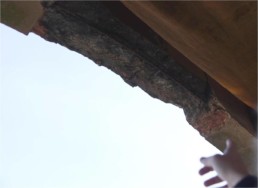
Example of rusting and loss of material on the reinforced concrete on one of the eaves on the north-west gallery, 2016. Source: Project for showcasing the Punta Begoña Galleries