
C.1 SYMBOL OF AN ERA
The early years of the 20th century were a turbulent time in which society was undergoing rapid changes. It was against this background that Horacio Echevarrieta (1870-1963) had the idea that led to the building of the Punta Begoña Galleries, a paradigm of the feverish pace of industrialisation in Bizkaia.
This unique structure is more than just a containing wall to shore up the cliff face: it is a reflection of the bold vision of a man whose business ventures extended across frontiers and provided the foundations for some of the most emblematic projects and most influential companies of the present day.
- The founding in 1918 of Saltos del Duero, which grew into the major utility company now called Iberdrola, and was responsible for bringing hydroelectric power to much of northern Spain.
- The construction of the renowned training vessel Juan Sebastián Elcano for the Spanish navy and the then state-of-the-art E-1 submarine at his Astilleros de Cádiz shipyard.
- The founding in 1927 of Iberia, Spain’s leading airline.
- The urbanising of the Gran Vía street in central Madrid and the construction of line 2 of the Barcelona Metro via his Cementos Portland Iberia, one of the country’s biggest cement plants.
- The construction of the “aerocar” over the Niagara Falls in 1916 via The Niagara Spanish Aerocar Co. Ltd.
He also had a hand in some of the most decisive historical events of his day:
- As a member of parliament for Bilbao (1914-1917) representing the Republican Socialist Coalition;
- As one of those who negotiated with the Riff chieftain Abd-el-Krim for the release of Spanish prisoners in the war in North Africa;
- As one of the founders of the “El Liberal” newspaper;
- Schemes set up with his friend and business partner Wilhelm Canaris, a German naval officer, for the rearmament of Germany between the wars.
He played a crucial role in all these and many other events, and always sought to maintain a strong international profile. It is hardly surprising, then, that he should have an innovative structure built for his own personal enjoyment that represented the state of the art of its day.
Construction work was directed by Ricardo Bastida, who at that time was the Chief Architect for Civil Work at Bilbao City Hall. The resulting structure was designed to enable its owner to enjoy the landscape, keep an eye on the extensive mining operations on his land on the far side of the Nervión-Ibaizabal estuary and watch the vessels run by his shipping companies as they plied their trade with foreign markets. It also served as a vantage point for watching the comings and goings of the new middle classes, who were turning Getxo into a benchmark seaside resort.
But the Punta Begoña Galleries were not just an exceptional viewing balcony: they were also a magnificent showcase at a strategic spot on the shoreline of Bizkaia, a place to see and be seen at the mouth of the trading port that served the growing metropolis of Bilbao.
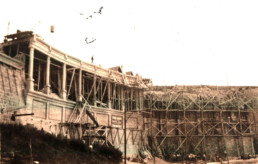
Photo of the main hall and north-west gallery during their construction, 1919-1921. Source: Municipal Archives of Bilbao
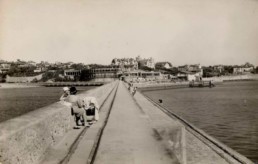
The Punta Begoña Galleries, the Echevarrieta family home and the great crane known as Titan, seen from the breakwater in Algorta (undated). Source: San Nicolás Library
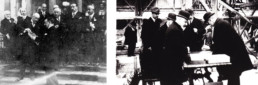
Left: Horacio Echevarrieta (third from the left) receiving a plaque from Basque MPs to commemorate his work in favour of the Economic Agreement between the Basque Country and the central government. The Assembly House in Gernika, 1925. Source: EuskoMedia.org. Right: Ricardo Bastida (on the far right) signing his name at the laying of the first stone of the Banco de Bilbao headquarters in Madrid, 1920. Source: published with the permission of Eloisa Larrea