
C.13 UNFORESEEN USES OF THE GALLERIES
The walls of the hall have a tale to tell, and many memories that we can bring to light. Although the galleries were built by Horacio Echevarrieta for his own private use as part of his family residence at Punta Begoña, social and historical events over the course of the 20th century led to their being used for other purposes. Just who used them and what for may well surprise you.
During the Spanish Civil War, women and children from the nearby Atxekolanda neighbourhood took refuge behind the wall where the fireplace stands, between the main hall and the cliff face, when the air raid warning sounded.
During the Civil War the devolved Basque government set up a health care network for troops, which entailed turning the house at Punta Begoña and several other residences in Getxo into convalescent hospitals.
After the fall of Bilbao on 18 July 1937, the Italian troops fighting on the Francoist side, known as the Corpo Truppe Voluntarie, established their headquarters at Punta Begoña. It was here that their commander General Bastico (known as “Doria”) took up residence.
The pictures on the walls here show the time when the hall was pressed into service as a charity kitchen by the Francoist social assistance organisation Auxilio Social. The symbols and figures shown are evidence of how this charity work was used as a propaganda tool towards the end of the Civil War. The Francoist imagery found includes the yoke and arrows, the Cross of Burgundy symbol of the Requeté militia, the volunteer nurses and the uniforms of the three combatants shown: a Falangist, a Carlist and a regular army private.
From the 1950s to the 1970s Horacio Echevarrieta’s grandchildren and their friends used the galleries as a playground. It was the perfect place to play tennis, race their bikes, organise concerts and explore the “dark tunnel” in the cliff face.
According to the deeds, the property at Punta Begoña was sold on 22 March 1976. After that it quickly began to fall into ruin. In the 1980s many of the houses in the area were disused. Much of the contents of the galleries and the decoration vanished as the site was scavenged as a source of building materials.
There is evidence that in the years before the agreement between Getxo Municipal Council and the University of the Basque Country the great walls and dropped ceilings of the main hall and the south-west gallery were used as a place to shelter by homeless people.
And then there is us: we ourselves are the latest episode in the fascinating history of the Punta Begoña Galleries.
Short documentary “Military Healthcare”
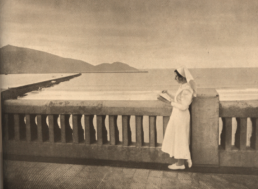
Photo of the nurse at the convalescent hospital set up at Punta Begoña leaning on the garden balustrade, 1937. Source: Historical Archives of the Basque Country (exp. C17/4)
For more information on this topic, visit the following points:
- A.2 LONG YEARS OF ABANDONMENT
- A.4 STRICT ACCURACY IN RESTORING AND SHOWCASING THE SITE
- A.5 A PARTICIPATIVE PROCESS IN THE SERVICE OF SOCIETY
- B.11 BEYOND PUNTA BEGOÑA. A LOOK AT THE LANDSCAPE
- D.16 GRAFFITI FROM THE 1980S
- E.3 REMOVING FILLINGS
- E.5 CLEANING OFF THE INK FROM GRAFFITI
- E.11 REMOVING RUBBLE