
D.1 SUBSIDENCE CONTROL EQUIPMENT
The gilt cylinder on the wall is the end of one of the three devices for measuring linear movements (strain gauges) that we have installed at Punta Begoña. These devices measure differences in tenths of a millimetre between an outside point and one or more anchoring points inside. To install them, we drilled a horizontal borehole, in this case to a length of 20 metres, in which we installed anchoring fixtures at 10 and 20 metres. Any movements between these points are automatically recorded, with a measuring accuracy of tenths of a millimetre.
In addition, these boreholes provide us with information on the materials they pass through when we study the sample cores obtained. In this case, after the sandstone that makes up the current wall, which is 40 centimetres thick, we encounter a five-metre long section of the north-west part of an earlier wall, which was made of marlstone masonry and a mortar of very thick quartz sand and a lime binder. Some old photos show this former construction that was partly dismantled when the galleries were built.
We installed this device at this specific point in order to check for any possible ground subsidence, assess the site’s safety, and monitor the slope to assess the effects of the refurbishment work on the south-west gallery and the increase in footfall involving the research team and visitors from the public.
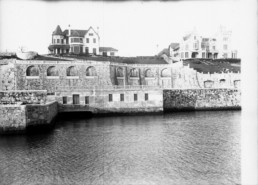
Wall before the galleries were built, (undated). Source: Archives of the Bilbao Port Authority
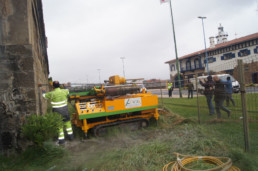
The team inserting the anchoring rods into the borehole, 2016. Source: Project for showcasing the Punta Begoña Galleries
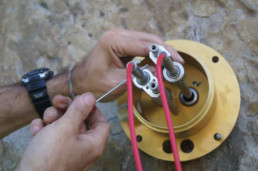
Installation of the measuring device, 2016. Source: Project for showcasing the Punta Begoña Galleries
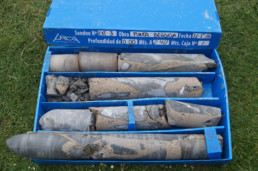
First box of sample cores taken from the two walls, 2016. Source: Project for showcasing the Punta Begoña Galleries