
A.4 STRICT ACCURACY IN RESTORING AND SHOWCASING THE SITE
The key here is to apply UNESCO criteria on the conservation and restoration built heritage, as set out in the Krakow Charter of 2000. Accordingly, no action can be taken on the structure until the conclusions of the investigation work are in. This guarantees that the work done is correct and consistent with the values of the structure.
Our guidelines are based on drawing up a “storyline” based on the value chain, where the work is not an end in itself but just one stage within a much broader process. The galleries are seen not just as a structure but as a repository of memories of a town, which recognises their importance in its history and their potential as a resource for economic and social development.
The value chain therefore consists of:
- documenting and recording the formal aspects of construction;
- assessing and establishing the meaning of biographical content;
- conserving the actual physical structure;
- turning the site back into a functional venue; and
- presenting the galleries as a landscape feature that enhances the character of the area.
This is part a process in which the socialisation of knowledge is an essential goal.
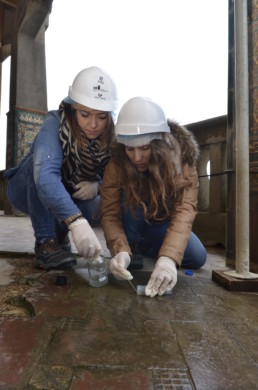
Members of the Environmental Analytical Chemistry Group (IBeA, UPV/EHU) collecting samples in the north-west gallery, 2015. Source: Project for showcasing the Punta Begoña Galleries
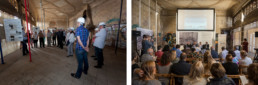
Left: Visit by public authorities: Getxo Municipal Council and UPV/EHU, 2015. Source: Project for showcasing the Punta Begoña Galleries. Right: Seminar under the title “Erronkak: territorial structure and globalisation: can we maintain our own identity?” Donosti 2016, 2016. Source: Project for showcasing the Punta Begoña Galleries
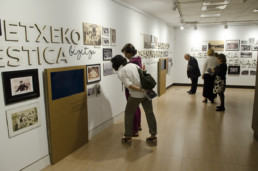
“Getxo: Collective Remembrance” exhibition at the Torrene gallery in Algorta, 2017. Source: Project for showcasing the Punta Begoña Galleries