
A.3 A MOVE WITH SIGHTS SET ON THE FUTURE
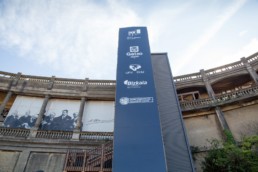
Exterior view of the north-west gallery and the north-west access scaffolding, 2017. Source: Project for showcasing the Punta Begoña Galleries
The abandonment and lack of maintenance suffered by the galleries, and their undoubted worth as a heritage site, led the Municipal Council of Getxo to act in cooperation with the Provincial Council of Bizkaia and the Basque Government to promote a complex project to ensure their survival. As a result, on 13 October 2014 an agreement was signed with the University of the Basque Country (UPV/EHU) to join forces in order to restore the site, based on the rigorous procedures, transparency and standards of quality demanded by UNESCO for heritage-related work, with research, action and social engagement as the indivisible cornerstones of the project.
To guarantee the standard of the work, the technical team from the municipal council that is directing and coordinating the project has enlisted the aid of five excellence-based research groups to work on the structure. Their expertise and experience have made this the biggest cross-disciplinary project undertaken by the UPV/EHU to date: it involves experts in the fields of history of art, hydrology, geology, chemistry, architecture, archaeology, history, anthropology, geotechnics, restoration and engineering, among others. In all, around 70 researchers are working to restore the site:
- The Environmental Analytical Chemistry Group (IBeA, UPV/EHU): This group studies the nature of the original materials used in the construction of the galleries, as this was the first private residence in Bizkaia to be built of reinforced concrete. The group also studies the impact of the environment on the structure (sea spray, atmospheric discharges from industry, influence of the port facilities and shipping traffic, colonisation by micro-organisms, etc.), and has found substances harmful to the gardens, the decoration and the materials themselves. The diagnostic analyses carried out have identified the problem compounds formed as the damage has built up, and proposed potential solutions.
- The Hydrogeology, Geotechnics and Environment Group (HGI, UPV/EHU): This group analyses the general stability of the hillside and its links with the galleries, assessing the foundations and potential thrust and monitoring the circulation of water through the area to determine whether it could affect the structure and draw up corrective and protective measures as necessary. It also works to identify the types of stone used in the construction, to enable restoration work to be carried out properly and rigorously, with mortars and concrete compatible with those originally used.
- The Built Heritage Research Group (GPAC, UPV/EHU): This group analyses the built structure itself and the documentation available on it, seeking to learn more about the historical identity of Punta Begoña and how the structure fits into and makes its mark on the cultural landscape. It has examined the stability of the structure with a view to designing stabilisation measures, checking for earlier constructions and determining whether they can be used to help understand the development of the structure and the damage from which it is currently suffering. It also studies the uses to which the galleries have been put over the years, so as to be able to interpret the pictorial evidence found. At the same time, careful attention is paid to the setting in which the galleries stand, so as to identify resources that may prove useful in showcasing the site.
- Fine Arts Faculty Cultural Assets Conservation Group (UPV/EHU): This group is working on how to recover the ceramics and stone used at Punta Begoña, following the strict procedures laid down by the Basque Heritage Act for work on sites declared to be of cultural interest.
- UNESCO Chair on Cultural Landscape and Heritage (UPV/EHU): This group works on participation processes within the project, with special attention on recovering tangible and intangible memories associated with Punta Begoña and setting up a conceptual basis and “storyline” that can lead to a management plan in the future for making the site functional again and turning it into a powerful social and economic resource.
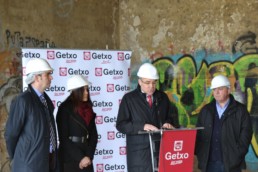
Presentation of the project for the restoration of the Punta Begoña Galleries, 2014. Source: Project for showcasing the Punta Begoña Galleries
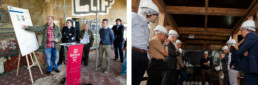
Left: Press conference at the “Getxo: Collective Remembrance” exhibition, 2017. Source: Project for showcasing the Punta Begoña Galleries. Right: Visit by public authorities: Getxo Municipal Council and UPV/EHU, 2015. Source: Project for showcasing the Punta Begoña Galleries
