
B.2 THE CURRENT LANDSCAPE: THE MAIN IMPACTS ON THE GALLERIES
The materials in the galleries have suffered damage due to a range of causes, including pollution from the industrial plants and factories that stood for many years on the left bank of the estuary. The ships stopping at the port and vehicle traffic on the roads around Punta Begoña have also had their impact. The river estuary itself and the sea spray, micro-organisms and plants have played their part too.
Several types of contaminant are involved:
- there are gases, especially acid fumes such as sulphur and nitrogen oxides and CO2 from the industrial plants, shipping and road traffic;
- there are liquid contaminants such as microscopic drops of salt water from the sea spray;
- and there are solids including particles of various sizes from the port or from vehicle traffic which are deposited on the surfaces of the structure and form a crust.
Gaseous contaminants dissolved in rainwater form acid rain, or in the sea spray, can also deposit solid particles on the structure and affect the galleries.
There is also biological damage caused by micro-organisms and plants, which form coloured layers on the surface. Plants also grow on the structure itself, causing not just cosmetic damage but also cracks in the materials.
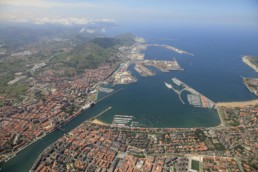
Aerial view of the El Abra bay (undated). Source: Archives of the Bilbao Port Authority
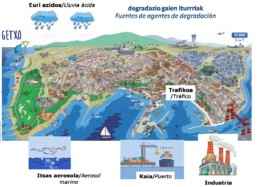
Sources of damage affecting the Punta Begoña Galleries. Source: The project to showcase the Punta Begoña Galleries, in an image published by Getxo Municipal Council
For more information on this topic, visit the following points:
- D.2 TECHNIQUES FOR ANALYSING THE MATERIALS IN THE GALLERIES
- D.4 THE STALACTITE PHENOMENON
- D.5 APPEARANCE OF THE BLACK CRUST
- D.6 HONEYCOMB WEATHERING
- D.12 THE EFFECTS OF WATER
- D.14 RUSTING ON THE REINFORCED CONCRETE
- E.4 PREVENTIVE SHORING
- E.6 REMOVING LIMING
- E.7 REMOVING AIRBORNE POLLUTANTS
- E.10 REMOVING OFF-WHITE PATINAS