
E.6 REMOVING LIMESCALE
People are not the only ones to have damaged the tiling in the Punta Begoña Galleries. If you look carefully at the surface you can see that in addition to scrawls, symbols and images, other materials conceal their lustre and colour.
Limescale refers to the damage caused to the tiling on the walls, columns and floors that takes the form of layers of lime and lime crusts, which are formed by the dissolution of certain limestone components in walls and ceilings in the presence of damp, leading to a curtain of limestone water.
The stages involved for their restoration are as follows:
- Stage 1: inspection of the area to be treated, with removal of the layers of sand, dust and various kinds of dirt.
- Stage 2: start of work by applying a specific paint stripper for removing limescale.
- Stage 3: gentle rubbing with natural bristle brushes made of plant material to blend the limescale stripper into the limescale crust.
- Stage 4: removal by scraping off the limescale paste.
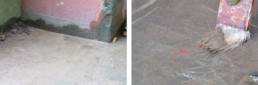
Process of removing limescale: stage 1 inspection of the area to be treated on the floor in the north-west gallery (left) and stage 2 application of the chosen limescale remover (right), 2017. Source: Project for showcasing the Punta Begoña Galleries
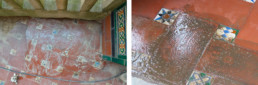
Process of removing limescale: stage 3 rubbing the surface with limescale (left) and stage 4 removing the limescale paste (right), 2017. Source: Project for showcasing the Punta Begoña Galleries
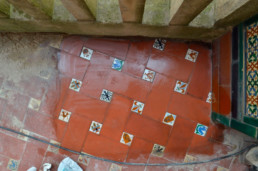
Process of removing limescale: stage 5 removal of limescale paste through repeated rinsing with water, 2017. Source: Project for showcasing the Punta Begoña Galleries