
C.11 SEVILLE-STYLE DÉCOR
The unique nature of the Punta Begoña Galleries is enhanced by the large areas of brightly coloured tiles and reliefs in various forms including slabs, panels, plinths and slats, arranged into strikingly beautiful mosaic patterns.
The style is based on the Nasrid dynasty decoration found in the Alhambra Palace in Granada, which was in vogue at the time when the galleries were built. Similar decorative motifs can be found in the Café Iruña and the Doña Casilda Park in Bilbao.
Most of the decorative tiles used were made in what is known as the Spanish-Moorish style, which dates back to the 15th century, and is produced by mechanically pressing a motif into the fresh clay with a mould and then painting it.
The chemical composition of the clay used is as distinctive as a fingerprint, and enables the geological characteristics of the materials to be identified. This helps to establish where the tiles were made. More than 100 fragments have been analysed using a technique known as ICP-MS, or inductively coupled plasma mass spectrometry. The results have been compared to samples whose places of origin are known, such as Seville and Barcelona, and it turns out that the tiles used in the galleries were made in Seville. Specifically, they were produced at the Mensaque factory, one of the busiest at that time, and one that is in fact still producing tiles today.
Over and above their value as decoration, these tiles bear silent witness to the changes suffered by the site over the years. As well as their provenance, the analysis of the clay in the tiles reveals a great deal about the trade routes of the past. An analysis of the glaze brings to light further details of their history and the history of architecture itself, of the social status of the people who used them and of the environmental wear and tear to which they have been subjected over time.
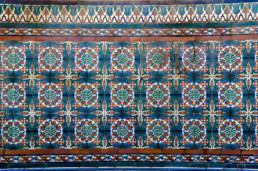
Mosaic tiles in the south-west gallery, 2016. Source: Project for showcasing the Punta Begoña Galleries
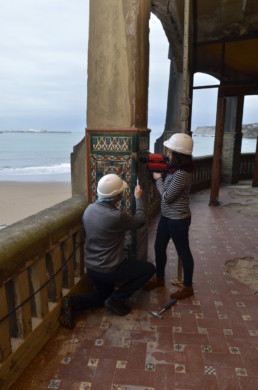
Member of the Built Heritage Research Group (GPAC, UPV/EHU) conducting non-destructive analyses on tiles, 2016. Source: Project for showcasing the Punta Begoña Galleries
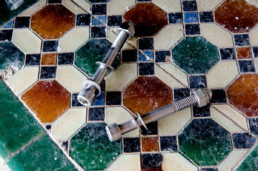
Detail of the tiling on one of the benches in the north-west gallery, 2016. Source: Project for showcasing the Punta Begoña Galleries
For more information on this topic, visit the following points:
- A.2 LONG YEARS OF ABANDONMENT
- A.4 STRICT ACCURACY IN RESTORING AND SHOWCASING THE SITE
- D.2 TECHNIQUES FOR ANALYSING THE MATERIALS IN THE GALLERIES
- D.16 GRAFFITI FROM THE 1980S
- E.3 REMOVING FILLINGS
- E.5 CLEANING OFF THE INK FROM GRAFFITI
- E.6 REMOVING LIMING
- E.7 REMOVING AIRBORNE POLLUTANTS
- E.10 REMOVING OFF-WHITE PATINAS
- E.11 REMOVING RUBBLE