
B.10 THE AGE OF THE ROCKS
One of our research projects involves dating the various strata of rock that make up the cliff.
To establish the relative ages of the rocks, we examine the micro-fossils preserved in them of ancient plankton that lived in the sea when each stratum was formed. Different fossil species can be associated with different eras, enabling us to date the samples studied.
Samples for dating are taken to a laboratory, where they are ground up and sifted through sieves with pre-set mesh sizes, in a process known as “levigation”. We then study the resulting material through a powerful binocular microscope to classify its fossil content.
At Punta Begoña we have found fossils dating from the Cretaceous period, such as white shells called Globotruncanita sp.; and from the Lower Tertiary period, such as the reddish, spherical shells of a species called Subbotina sp.
These finds are significant, in that they enable us to date the cliffs at Punta Begoña to the transitional period between the Cretaceous, when dinosaurs still roamed the earth, and the Lower Tertiary, after the mass extinction that ended their reign.
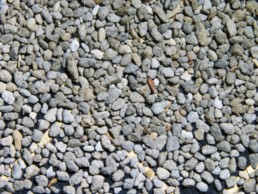
Microscope image of grains after sifting, 2017. S Source: Project for showcasing the Punta Begoña Galleries
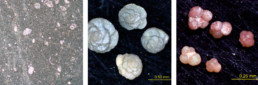
Left: Thin-film samples of fossils from the Cretaceous, 2017. Centre: Magnified image of fossils from the Cretaceous, 2017. Right: Magnified image of fossils from the Lower Tertiary period, 2017. Source: Project for showcasing the Punta Begoña Galleries
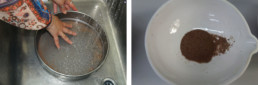
Left: Sifting a sample, 2017. Right: The sample obtained, 2017. Source: Project for showcasing the Punta Begoña Galleries