
D.11 SUPPORTING THE GALLERIES
The design of a building’s foundations is determined by the nature of the ground it stands on, as different materials behave in very different ways. The best materials for foundations are obviously rocks, as they are in theory extremely strong and change little. Soils tend to act in many different ways, sometimes negatively, above all if they are damp.
When the ground is not strong enough to directly support a building, use is made of more ingenious types of foundations. When the nearby transporter bridge, the Puente de Bizkaia, was built, the surface rock on the west bank in Portugalete meant the tower on that side could be erected directly on the ground. On the other side of the river in Getxo, however, the sandy soil (the origin of the name of Las Arenas – The Sands) rendered it advisable to drive piles into the subsoil to provide the foundations for the tower on that bank.
The foundations of the Punta Begoña Galleries stand on Flysch rock of different strengths (resistance), which is being assessed through samples (pieces of rock) collected through the boreholes.
Besides studying the type of materials we are building on, it is important to understand their stratification and, given that the galleries adapt to the slope on the cliffside, measuring these layers is essential. To do so, we are using precision compasses to take readings at numerous points on the cliff, both of the rock strata (i.e., how the layers of rock are arranged), and the joints identified between each one of them. At the same time, we are studying the rock core samples collected through the boreholes in which we also measure any discontinuities between them.
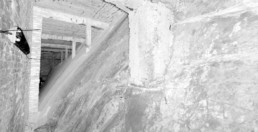
Example of a true view image of the pillars in the south-west gallery, 2017. Source: Project for showcasing the Punta Begoña Galleries
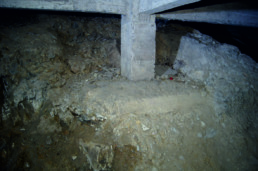
Example of the footing for a pillar (foundation) on the cliff, 2017. Source: Project for showcasing the Punta Begoña Galleries
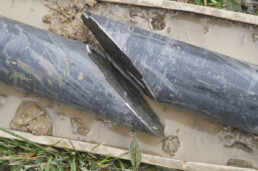
View of the joint in a rock sample, 2017. Source: Project for showcasing the Punta Begoña Galleries
For more information on this topic, visit the following points:
- B.3 NEW AREAS TO BE DISCOVERED
- B.4 THE RURAL GETXO OF THE PAST
- B.7 DEFENDING THE EL ABRA BAY: THE BEGOÑA GUN BATTERY
- B.8 GETXO UNDER THE SEA
- B.9 FLAT LAND AND CLIFFS
- B.10 THE AGE OF THE ROCKS
- B.11 BEYOND PUNTA BEGOÑA. A LOOK AT THE LANDSCAPE
- C.3 THE TERRACING WALL UP TO THE GALLERY
- C.6 THE PROJECT THAT WAS GRADUALLY ADAPTED TO THE SITE
- E.9 REDISCOVERING CONCEALED AREAS
- E.13 TURNING WEAKNESSES INTO OPPORTUNITIES