
B.7 DEFENDING THE EL ABRA BAY: THE BEGOÑA GUN BATTERY
It was in the 16th century that government authorities first became involved in the defence of the El Abra bay. Up to that time control of the strategic defensive points along the coast had been disputed by rival noble families. In the late 15th and early 16th centuries the crown, and especially the city authorities and merchants’ guild of Bilbao, took over the defensive strongholds around the bay, building and maintaining a number of coastal gun batteries distributed strategically across the area. And this was how things stayed until well into the 19th century, when most of the batteries fell into disuse.
The Begoña Gun Battery
The Begoña headland was fortified by Baltasar de la Cruz in 1639, during the 30 Years’ War with France. Trenches and embankments were constructed and two short cannon were set up here in 1640. The position was abandoned some years later, and was not defended again until it was completely remodelled by General Antonio Gaztañeta at the beginning of the next century. Records of his tour of the fortifications around the El Abra Bay in 1726 indicate that this position had a parapet wall overlooking the estuary. It was built of stone blocks with gun openings and finished with earthwork battlements. Another defensive wall with gun openings closed off the rear of the site. Inside the walls were two gun emplacements, each with a storeroom attached.
From 1759 to 1827 or 1828 the site became less important and gradually deteriorated, in spite of some maintenance work. At the turn of the 19th century it was turned into a quarantine station, at least until 1803. After that it clearly fell into disuse. The last attempt to restore the fortifications at Punta Begoña took place in 1827 and 1828, when the Provincial Council rebuilt the walls and installed seven artillery pieces.
In spite of this rebuilding work, by the beginning of the first Carlist War in 1833 the fort had once again fallen into ruin. This time that ruin would be permanent.
The end of the history of the site as a defensive battery came in 1860, when the central government put it on sale. The bill of sale described it as “…que fue castillo “Begoña” en Archecolandetas de Algorta…” (the former Begoña Castle at Achecolandetas in Algorta). It was purchased by José Maria de Mendizabal of Bilbao in 1861 for the price of 7500 reales. In 1888 he sold it to Quirino Pinedo, also of Bilbao, who eventually sold it to entrepreneur Horacio Echevarrieta in 1904. Over the next six years, Echevarrieta also bought up adjacent sites until he had amassed a property measuring over 12,000 m2.
There are no further records of the gun battery after that time, so it can be assumed that what little was left of it was buried during the work to build the Echevarrieta family home in 1910 and the galleries in 1918.
Several surveys conducted in the area have failed to turn up any contemporary evidence of the remains of this battery.
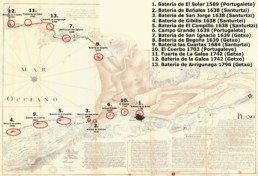
Chart of the El Abra Bay showing the positions of the coastal gun batteries. Source: The project for showcasing the Punta Begoña Galleries, in an image published by Getxo Municipal Council
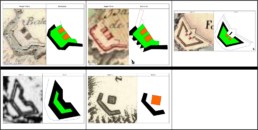
Various depictions of the gun battery taken from historical maps. Source: The project for showcasing the Punta Begoña Galleries, from documents drawn from various sources
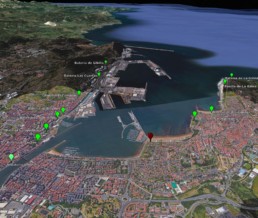
Positions of the old gun batteries superimposed on a current picture of the El Abra Bay. Source: The project for showcasing the Punta Begoña Galleries, from a Google Earth picture