
B.8 GETXO UNDER THE SEA
During the Cretaceous period, around 75 million years ago, the rocks that now form the cliff face were on the sea bottom at a depth of 1000 m. They were formed by sediments washed down the continental slope by strong currents. As the strength of the current decreased, layers of fine material were deposited, resulting in the alternating strata known as “flysch” that can be seen in most of the cliffs along the Basque coastline.
These sea-bottom deposits were forced up to the surface as the Iberian tectonic plate pushed against the European plate during the formation of the Alps, which ended around 20 million years ago. The Pyrenees were formed by the same process.
The nearly vertical strata that can be seen today on the cliff where the galleries were constructed are evidence of the tremendous force of those movements.
If you look through the gaps in the partition walls of the galleries you can see the various strata of rock that form the cliff, looking like a cutaway drawing of the geological history of this part of the Basque-Cantabrian basin.
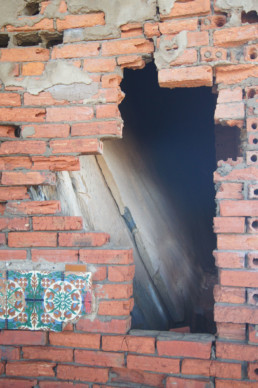
Vertical strata in the south-west gallery, 2017. Source: Project for showcasing the Punta Begoña Galleries